
XPRIMM: Over the past five years, the insurance market has grown 3.5-fold. In your view, what factors drove this growth? What significant events would you highlight as having played a key role in this process?
Kamoliddin ABDURAKHIMOV: Over the past five years, Uzbekistan’s insurance market has indeed demonstrated very strong growth momentum. In my view, this result stems not from a single factor, but from a combination of structural changes occurring both in the national economy and within the insurance sector itself.
First and foremost, I would highlight the liberalization and ongoing reform of the insurance market. In recent years, Uzbekistan has established a more modern regulatory framework, tightened requirements for the financial stability and corporate governance of insurance companies and increased the role of risk-based regulatory approaches. This has created clearer operating rules for market participants and boosted confidence in insurance as a financial instrument.
A second key factor is the expansion of insurance coverage and the development of compulsory insurance lines. Insurance is gradually moving beyond traditional products to become part of broader economic processes—such as business protection, employer liability coverage, and management of transport, property, and other risks. At the same time, demand from the corporate segment is rising.
A third factor is the growth of the economy and entrepreneurial activity. Business expansion, increased investment volumes, and development of construction, industry, transport, agriculture, and the financial sector are objectively creating new insurance needs. As economic relationships become more complex, the need for professional risk management also grows.
I would also highlight the digitalization of the insurance market. Digital services, process automation, development of remote customer interaction, and use of data are gradually transforming insurers' business models. This enables them to reduce operating costs, accelerate claims settlement, and make insurance products more accessible.
Competition among insurance companies has also played a significant role. Market players have become more active in enhancing their product offerings, service quality, digital sales channels, and professional expertise. As a result, insurance companies are gradually shifting from a model focused primarily on selling policies to one centered on comprehensive client risk management.
As for the most significant developments, I would highlight the transition to a new phase of state regulation of the insurance market, stricter requirements for insurer solvency, the industry's digital transformation, expansion of compulsory insurance lines, and the creation of new support mechanisms for specific lines, such as agricultural insurance.
In my view, it is particularly important that we are currently witnessing not merely quantitative market growth, but a gradual qualitative shift. To ensure further development, we must move beyond mere expansion of premium volumes and focus on increasing actual insurance coverage, improving claims settlement quality, fostering long-term insurance products, refining actuarial models, and expanding reinsurance capacity.
For this reason, I consider the coming years just as crucial for the Uzbek insurance market as the preceding five. The primary objective is to maintain a high growth rate while simultaneously strengthening insurers' financial stability, enhancing the quality of insurance services, and boosting public and business confidence in insurance.

XPRIMM: In the first half of the year, the market recorded a rise in GWP, paid claims, the number of insurance contracts, and charter capital of insurance companies. What new market trends would you highlight compared to the same period last year, and what was the dynamic overall?
K.A: The first-half results indicate that Uzbekistan’s insurance market has maintained strong positive momentum. In my view, however, what matters is not merely the growth of individual indicators, but the fact that the market is developing in several directions simultaneously.
Over the six-month period, GWP rose by 28.6% to approximately UZS 8 trillion, the number of active policies increased by 14.9% to 13.1 million, and total charter capital of insurance companies grew by 37.2%, reaching UZS 4.3 trillion. Paid claims saw particularly notable growth, surging by 81.3% to UZS 2.3 trillion.
I would single out the last figure for special mention. The significant rise in paid claims demonstrates that, alongside the expansion of the insurance business, insurers are fulfilling a growing volume of obligations to their clients. This is crucial for the market's future development, as consumer trust is built primarily through first-hand experience of claims settlement.
Another significant trend is the strengthening of insurers' financial stability. The growth of charter capital is outpacing that of premiums, creating additional opportunities to underwrite larger risks, expand corporate insurance, and increase retention levels when insuring major assets. At the same time, total insurance liabilities rose by 48.4%.
In my view, the market structure is gradually changing. We are witnessing a continued expansion of voluntary insurance, the development of coverage for large-scale property and corporate risks, and an increased focus on reinsurance. The market is becoming more professional and capital-intensive, while competition among insurers is shifting away from mere business volume growth toward product quality, service standards, and the capacity to underwrite and manage more complex risks.
At the same time, I would not assess current trends solely based on premium growth rates. It is more important that premiums, paid claims, the number of policies, and insurer capital are all rising simultaneously. This points to a steady expansion of the insurance market and a gradual increase in its role within the country's financial system.
Overall, I would characterize the first half of 2026 as a period of active quantitative and qualitative market growth. In my opinion, the next crucial stage should involve translating this growth into deeper regional market penetration, the development of new insurance products, improved accessibility for individuals and businesses, and further refinement of claims settlement and reinsurance mechanisms.
XPRIMM: How would you describe the market portfolio structure in the first half of the year? Were there any notable shifts across segments (voluntary insurance, compulsory insurance, and life insurance)?
K.A: In the first half of 2026, the insurance market continued to show steady growth. According to data from the National Agency of Perspective Projects, total GWP for the reporting period reached UZS 8.02 trillion, an increase of 28.6% y-o-y.
At the same time, the market saw some shifts within the structure of the insurance portfolio. Non-life insurance accounts for approximately 93% of GWP, down from 94% a year earlier. In the non-life sector, voluntary insurance remains clearly dominant: of the roughly UZS 7.46 trillion in premiums collected, approximately 88.7% came from voluntary insurance and about 11.3% from compulsory insurance.
However, the two segments are growing at markedly different rates. Voluntary insurance rose by 21.8% to UZS 6.62 trillion, whereas compulsory insurance recorded a much higher growth rate - 110.7% - reaching UZS 875.7 billion. Yet despite the more than twofold increase in compulsory insurance, voluntary insurance products still account for nearly nine-tenths of non-life premiums.
In my view, this is a key market trend: while compulsory insurance is currently growing at an accelerated pace and gradually expanding its footprint, voluntary insurance remains the backbone of the insurance portfolio, underscoring the enduring importance of market demand from both the public and the business sector.
I would also like to highlight the life insurance sector specifically. In the first half of 2026, life GWP totaled UZS 524.8 billion, marking a 36.6% increase y-o-y. Life insurance thus grew faster than the market as a whole, and its share in total GWP rose from approximately 6% to 7%.
In the life insurance sector, voluntary life insurance predominates. In the first half of 2026, it generated UZS 497.7 billion, or about 94.8% of all life insurance premiums, whereas compulsory life insurance generated only UZS 27.1 billion, or approximately 5.2%.
However, in our view, the current share of life insurance must be assessed in the context of long-term market trends. Following the abolition of personal income tax relief for funds allocated to long-term life insurance, the attractiveness of such products to the public declined. This has had a negative impact on premium volumes and the role of life insurance in the market compared to the period when tax incentives were in effect.
Therefore, despite the positive trends observed in 2026, the share of life insurance - at around 7% - remains relatively small. By comparison, in developed insurance markets, life insurance traditionally accounts for a significantly larger share of the market.
In our view, strengthening the role of life insurance represents a key opportunity for further development of Uzbekistan’s insurance market. This requires fostering sustained, long-term consumer demand for savings-related and protection-focused products. In this regard, it would be advisable to consider reinstating or introducing new tax incentives and other economic measures to encourage long-term life insurance.
Overall, the market structure in the first half of 2026 can be described as reasonably stable, although a high concentration of premiums in non-life insurance persists. At the same time, we view the faster growth rate of life insurance as a positive signal, yet we believe its current share remains well below its full potential.
XPRIMM: How was the situation with paid claims in the reporting period? Were there any significant losses that impacted insurers' payments? And how has the risk landscape in the market evolved over the past five years?
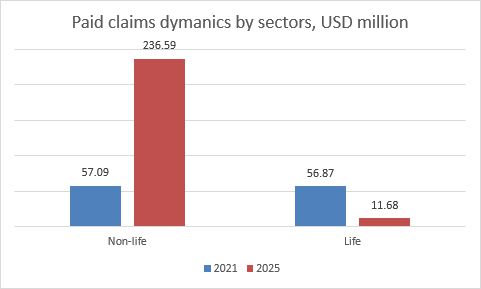
K.A: A comparison of the first halves of 2022 and 2026 reveals that Uzbekistan’s insurance market has grown significantly, though the nature of paid claims has shifted. Over this five-year period, paid claims roughly doubled - rising from UZS 1.15 trillion to UZS 2.25 trillion - yet the payout-to-premium ratio fell from approximately 42% to 28%. This indicates that the rise in paid claims is occurring against the backdrop of a much broader expansion of the market itself.
In 2022, paid claims were heavily affected by the rapidly growing life insurance sector; by 2026, however, the burden on insurers had increasingly shifted to non-life insurance - specifically risks related to motor vehicles, property, corporate operations, health, and liability.
I see no grounds to attribute the rise in paid claims during the first half of 2026 to a single major insurance event. Rather, it reflects the cumulative effect of a growing insurance portfolio and an increase in the volume of settled claims.
The nature of risks has also changed over the past five years, becoming larger, more complex, and more interconnected. Consequently, high-quality underwriting, capital adequacy, actuarial assessment, retention limits, and effective reinsurance have become particularly critical for the market today.
XPRIMM: How did market concentration shape up in the first half of the year compared to the previous year? What can you tell us about the leading companies based on the first-half results?
K.A.: In the first half of 2026, market concentration increased slightly compared to the same period last year, but I would not speak of a sharp change in the market structure. Rather, we are seeing the largest insurers strengthen their positions, while several second-tier companies are growing quite actively.
If we look at the non-life sector, which dominates the market, total net insurance premiums increased from UZS 3.72 trillion in the first half of 2025 to UZS 5.45 trillion in the first half of 2026, a rise of 46.2%. At the same time, the share of the three largest insurers increased from approximately 44.7% to 45.7%, and that of the five largest rose from 60.1% to 61.6%. The ten largest companies already account for about 79.6% of the non-life sector, compared with about 77.5% a year earlier. This indicates a slight increase in concentration, although the change cannot be called dramatic.
APEX INSURANCE remains the leader. In the first half of 2026, the company collected UZS 1.524 trillion in net insurance premiums, an increase of 41.2% y-o-y. Thus, APEX INSURANCE maintains a significant lead over other players and remains the largest non-life insurer.
MY-INSURANCE ranks second with UZS 483.9 billion, marking a 36.5% increase. KAPITAL SUG‘URTA ranks third with UZS 480.9 billion, seeing its premiums surge by 108.2%. Uzbekinvest posted an almost identical figure of UZS 480.2 billion (+53.8%). It is worth noting that the gap between the second- and fourth-ranked companies has narrowed significantly compared to the previous year.
Another notable player is Gross Insurance Company, whose net premiums increased from UZS 261.9 billion to UZS 385.5 billion over the year (+47.2%). KAFOLAT Insurance Company saw even stronger growth, rising from UZS 153.3 billion to UZS 294.3 billion (up 92%). This indicates that competition among major insurers is intensifying noticeably.
At the same time, I would draw attention to more than just the top five. Among the fast-growing companies, INFINITY INSURANCE stands out with a 163.1% increase in net premiums, as does Imkon-Sug‘urta, with growth of nearly 293%. While their absolute volumes remain significantly lower than those of the market leaders, this dynamic demonstrates that the market is not entirely static; some relatively small players are rapidly expanding their presence.
Concentration is significantly higher in the life insurance sector. APEX LIFE INSURANCE is the undisputed leader here, with net insurance premiums rising from UZS 248.2 billion to UZS 380.9 billion (+53.4%). However, the entry of new players, specifically PRESTIGE INSURANCE, and the rapid growth of TBC SUG‘URTA indicate that a more competitive environment is gradually taking shape in the life insurance sector as well.
In my view, the most significant trend of the first half of the year is that, while market concentration remains high, there is an active reshuffling of market positions among the major companies. Although APEX INSURANCE maintains a solid lead, the companies occupying the subsequent positions are growing at widely varying rates, and the gap between them is narrowing.
I consider this a positive signal for the market. On the one hand, large insurers possess the capital and resources necessary to handle major corporate risks. On the other hand, heightened competition between large and mid-sized players should drive improvements in insurance products, claims settlement quality, service offerings, and reinsurance capabilities.
Overall, I would describe the first half of 2026 as a period of slightly rising market concentration, accompanied by growing competition within the group of market leaders itself. The market is expanding, and insurer capitalization is rising, while the battle for market position is increasingly determined not only by premium volume but also by the ability to effectively manage large and complex risks.
XPRIMM: What are the prospects for the market through the end of the year, in your view? Are there any new measures planned that could impact the operations of insurers?
K.A.: Through the end of 2026, I expect the insurance market to maintain its strong momentum. In my opinion, further growth will be driven not only by an increase in GWP, but also by the expansion of insurance coverage and the emergence of new mechanisms to stimulate demand.
One of the most important developments is the preparation of a comprehensive reform of the insurance market. In July 2026, the draft Presidential Decree “On additional comprehensive measures to expand insurance protection for the population and business entities and strengthen the stability of the insurance market” was submitted for public discussion. The document provides for a number of changes, some of which are to be implemented through 2030.
I would highlight several areas of this reform:
Firstly, it is proposed to develop compulsory insurance of real estate against natural disasters. The draft provides for the creation of a special Fund for compulsory real estate insurance against natural disasters, based on a model that also takes into account Türkiye’s experience. For citizens included in the social register, insurance premiums will be reimbursed from the state budget. A bill in this area is to be submitted to the Cabinet of Ministers by January 1, 2027.
I consider the proposed package of incentives for life insurance to be particularly important for the market. The draft introduces a mechanism akin to "cashback" for long-term life insurance: it proposes reimbursing policyholders for premiums paid by reducing their personal income tax liability, with the reimbursement taking effect 13 months after the premium payment date.
In my view, this could be one of the most significant changes for life insurance, as the tax incentive has the potential to boost public interest in long-term life insurance while simultaneously encouraging a shift from short-term financial products to long-term savings.
Secondly, requirements for the financial stability of insurers are to be tightened. The draft outlines a phased transition toward Solvency II standards by 2030, the introduction of a mandatory appointed actuary for every insurance company, the use of escrow accounts for holding insurance premiums, and higher capitalization requirements. Specifically, there is a proposal to triple the minimum charter capital for life insurers and to quadruple it for non-life insurers and reinsurers.
In my opinion, this will lead to some market consolidation: capital, risk management, actuarial analysis, and the quality of corporate governance will become increasingly important for insurers. At the same time, for large and financially stable companies, these stricter requirements could create new opportunities to handle larger and more complex risks.
Another key area of focus is digitalization and stronger oversight. The draft proposal envisions further development of electronic document workflows and the use of digital tools—including artificial intelligence—to analyze contracts and combat fraud. Additionally, there is a proposal to automate monitoring of compulsory insurance policies of employers and carriers via state information systems.
Improvements to credit-linked insurance could also have a significant impact on the market. Under the proposal, business risk insurance would be limited to the non-collateralized portion of a loan (capped at 50% of the total amount), while for micro-loans to individuals, Class V life insurance policies issued by licensed insurers would be accepted as collateral.
Overall, I expect the market to continue growing at a robust pace through the end of 2026. However, the key focus will shift from just premium growth to the quality of that growth. If the proposed measures are implemented, the market will gain fresh momentum for the development of life, liability, property, and catastrophe risk insurance, while insurers will face clearer requirements regarding capital, solvency, and risk management.
I would describe the current phase as a transition from extensive market growth to institutional strengthening. The objective is no longer simply to collect more premiums, but to increase insurance penetration, boost public trust, expand insurance coverage across the economy, and make insurers more resilient to major losses.
Interview conducted by Marina Magnaval

